
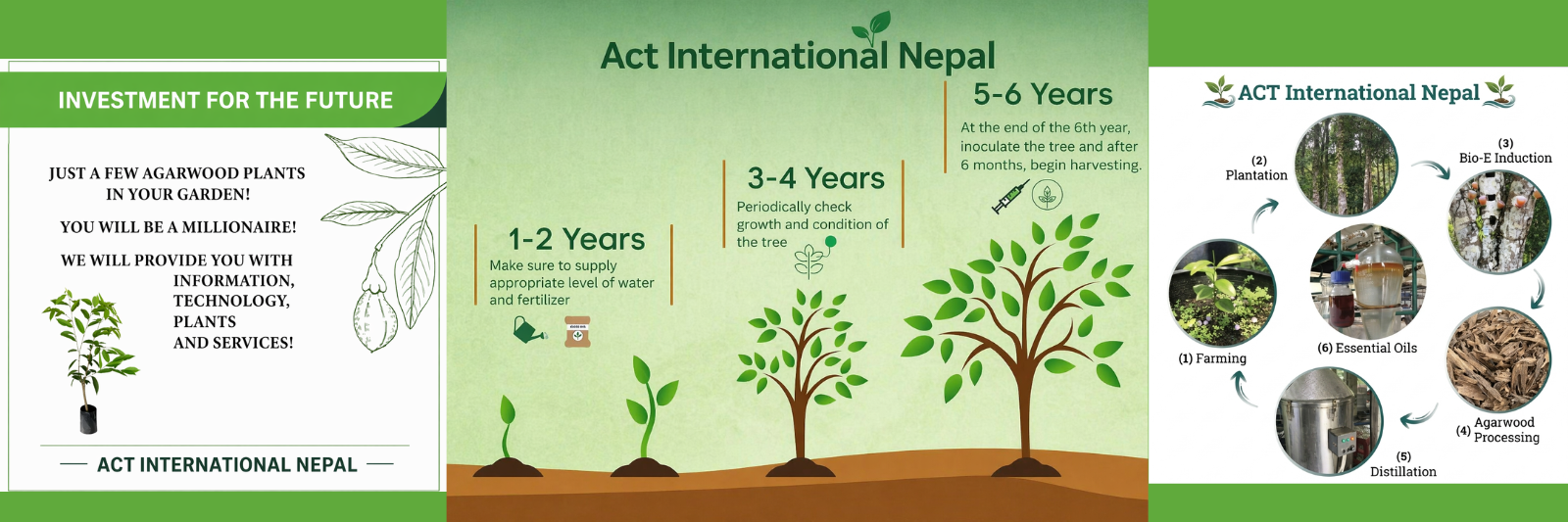
Agarwood (Oud) Farming
High‑value agro‑forestry for long‑term income | 40% Subsidy Contract Farming
From Terai to global markets – grow the world’s most valuable aromatic tree.
ACT International Nepal offers a 40% subsidy contract farming program under the National Economic Improvement Project (NED).
1. Introduction
Agarwood (Aquilaria spp.) is one of the most valuable forest products, used in perfumes, incense, traditional medicine, and luxury Oud oil. Nepal has strong potential for commercial Agarwood farming due to suitable climate and growing global demand.
Major Species
- Aquilaria malaccensis
- Aquilaria sinensis
- Aquilaria crassna
- Aquilaria subintegra
In Nepal, Aquilaria malaccensis and Aquilaria sinensis are mainly cultivated.
Climate & Geography
- Temperature: 20°C – 35°C
- Rainfall: 1,800 – 3,500 mm
- Altitude: 100 – 1,800m
- Soil: Well‑drained loamy or sandy loam
- Suitable regions: Terai, Chure, inner‑Madhesh
Cultivation & Processing
Nursery & Planting
Fresh seeds soaked 24h, nursery 6‑8 months. Transplant at 30‑40cm height. Spacing 3m×3m or 4m×4m. Pit 45³ cm with organic manure.
Management
Regular irrigation first 1‑2 years. Weeding 2‑3 times/year. Biological fungicides, minimal chemicals, field hygiene.
Inoculation (Core)
After 5‑7 years (diameter ≥15‑20cm). Methods: biological (fungus), chemical, or mechanical wound. Resin forms 2‑5 years.
Harvesting & Processing
After 8‑12 years. Resin‑rich parts only. Processing: cleaning, grading, chips/powder, oil distillation.
Agarwood Products
- Chips & powder
- Oud oil (distilled)
- Incense sticks & fragrances
Market Demand
International: Middle East, China, Japan, Korea, Europe, USA (luxury perfumes).
Domestic: religious use, Ayurveda, incense production.
Estimated Price Range
| Normal Agarwood | NPR 5,000 – 50,000 per kg |
| High quality | NPR 100,000 – 500,000+ per kg |
| Agarwood oil (Oud) | NPR 500,000 – 3,000,000 per kg |
⚠️ Risks & Challenges
- Long‑term investment (8‑12 years)
- Lack of technical knowledge
- Illegal trade & policy issues
✅ Opportunities
- High‑value cash crop
- Small land, huge income
- Export‑oriented, rural employment
Act International Nepal – 40% Subsidy Contract Farming Program
Project Background: Under the National Economic Improvement Project (NED), we provide 40% subsidy to farmers for Agarwood cultivation, ensuring technical support, market linkage, and risk reduction.
Objectives: Long‑term income stability, risk reduction, cooperation between farmers & private sector, export‑oriented production.
Contract Farming Model
ACT: coordination, subsidy, technical support.
Farmers: cultivation & protection.
Market partners: inoculation, processing, market assurance.
Subsidy Coverage (40%)
- Seedling purchase
- Land preparation & plantation
- Technical training & monitoring
- Partial inoculation cost
- Initial farming materials
Farmer contributes 60%.
Target Beneficiaries
Small/medium farmers, farmer groups, cooperatives, private landowners, long‑term investors (5‑10 years minimum).
Implementation Process
- Farmer selection & orientation
- Contract agreement signing
- Nursery & plantation
- Field management
- Technical monitoring
- Inoculation process
- Harvesting & processing
- Market management
Estimated Income Model (per 1 Ropani, ~50 plants)
| Total investment | NPR 83,667 |
| 40% Subsidy (ACT) | NPR 33,467 |
| Farmer contribution (60%) | NPR 50,200 |
| Expected income per tree (8‑12 years) | Minimum NPR 3‑5 million | Average 5‑8 million | High quality 10 million+ |
Market Assurance
- Guaranteed purchase under contract
- Price based on quality grading
- Export facilitation support
Risk Management
- Contract‑based price protection
- Technical supervision
- Insurance support
- Intercropping options
Conclusion
Agarwood farming is a highly profitable and sustainable agro‑forestry system for Nepal. With ACT International Nepal’s 40% subsidy and technical support, farmers can achieve significant long‑term income, contribute to rural development, and participate in global markets.
Interested in Agarwood Contract Farming?
Contact us for registration, training, and subsidy details.